


Search
Shift Synchronization
Example PowerShell script
Statistics
Supervisor
Agent
SocialConversationParticipant Export
SocialConversationInfo Export
SocialQueue Export
Virtual Call Info
Quality Assurance
Sentiment
Summary
Transcript
MCP Server Setup
Customer data
General
Create App Registration for Email TouchPoint
Module settings
Examples
Setup Access
Configure Teams client to enable Toastar
Enable users
Webhook & Postback URL
Add TOASTAR App to Teams
Create Teams Virtual User
Register Azure BOT Channel
Example PowerShell script
Phonebook
Webchat to Teams
WhatsApp to Teams
Recognize customer by email
Use webchat form to recognize customer
Start voice call (Beta)
CRM
AddTranscript
Translate
OpenAI
GetFormInput
HttpAction
Go to
Convert Image
SetAction
GetPageVisits
Sentiment
Powerhook
SendEmailAction
Chatbot
Get Transcript
Set Participant
Schedule
Merge
Choice
WaitInput
SendMessageTo
The basics
Webhooks for SMS Provider
Sandbox cm.com
WhatsApp OUT
Adding templates
Webhooks for WhatsApp Providers
Customize Layout
Add status message
Webchat Parameters
Create adaptive card
Connect Teams Channel
Add ROGER365 app to Teams
AI Endpoints
Classification Action Configurations
Quality Assurance Forms
Audio Providers
Flows
Last Conversation Data
Call to SMS (Beta)
Store feedback
Call to WhatsApp (Beta)
Cancel Virtual Call
Get Virtual Call Info
Make Call Virtual
OpenAI
Last agent
Text to Speech
Speech to Text
VoiceRecording
Switch
Subflow
Set Variable
Send Webhook
HTTPAction
Wait Timer
CRM
Cancel Task
Cancel all Tasks
Queue
Get Queue Info
WaitForEnd
Set language
Safe Transfer
Schedule
Contact Center
Setup Access & Security
Schedules
Resource Accounts
Queues
Callflows
Audio Files
Agents
Logging
Audit
CRM
Languages
Create Tenant App
Getting started
Subscriptions
Call Flows
AI Flow
Copilot Touchpoint
Insights & Analytics
Wallboard
Permissions
Logging
CRM Calling Integration (Toastar)
Custom CRM Connector
Default CRM Connectors
CRM Replicator
Email Configuration
Schedules
Agent Assist
Setup Access & Security
Malicious File Blocking
Wallboard
Reporting
Messages
Examples
Graphical Designer
Using the library
Email Touchpoint
API TouchPoint
Facebook TouchPoint
SMS TouchPoint
WhatsApp for Business TouchPoint
Webchat TouchPoint
Microsoft Teams
Queues
AI Flow (Beta)
Classification
Skill Based Routing
Reason Codes
Audio Prompts
Agent Profiles
Agents
Call Park
Resource Accounts
Graphical Designer
Form Based callflow
Using the library
Queues
General
Agent page functionalities
Social Messaging
Contact Center
Support & Assistance
Compliance by design
Social Messaging
Contact Center
Getting Started
General
No results
Try a different search query
Skill Based Routing

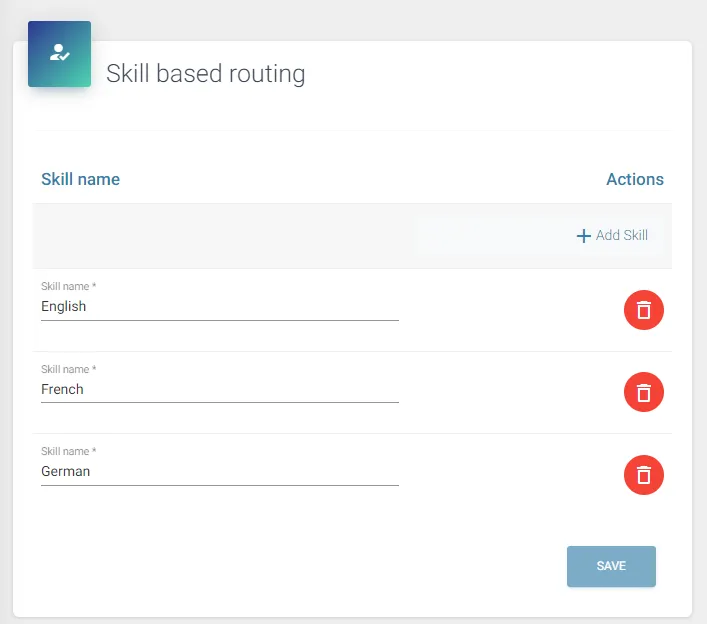
To route incoming calls to an agent with the highest skill on a certain subject, you can use the Skill Based Routing Method. The following steps are required:
- Create the skills (see underneath)
- At the Agents configuration, add the skills and the agents’ skill level to the agent
- Enable Skill Based Routing at the queue configuration and select the skills required for the queue
Example Algorithm: Skill-Based Routing
Consider a queue configured with serial and skill-based routing, containing a skill named 'A':
- Agent 1: Skill 'A', Value: 100
- Agent 2: Skill 'A', Value: 100
- Agent 3: Skill 'A', Value: 50
The routing process proceeds as follows:
- A call comes in. The system selects from agents not yet called (called: none) with the highest available skill level for A (100), resulting in Agent 1 and Agent 2. Due to serial routing, Agent 1 receives the call.
- Agent 1 does not answer.
- The system selects from agents not yet called (called: 1) with the highest available skill level for A (100), resulting in Agent 2. Due to serial routing, Agent 2 receives the call.
- Agent 2 does not answer.
- The system selects from agents not yet called (called: 1, 2) with the highest available skill level for A (50), resulting in Agent 3. Due to serial routing, Agent 3 receives the call.
- Agent 3 does not answer.
- The system selects from agents not yet called (called: 1, 2, 3) — none remain, so the list resets — with the highest available skill level for A (100), resulting in Agent 1 and Agent 2. Due to serial routing, Agent 1 receives the call.
- This process repeats as needed.
When a queue is configured with multiple skills, skill levels are not summed but treated as equal. For example, in a queue requiring skills A and B, an agent with Skill A at value 100 is considered equivalent to an agent with Skill B at value 100